

Key takeaways
- —Fixing what is actually wrong at a company requires deep thinking—not just project management.
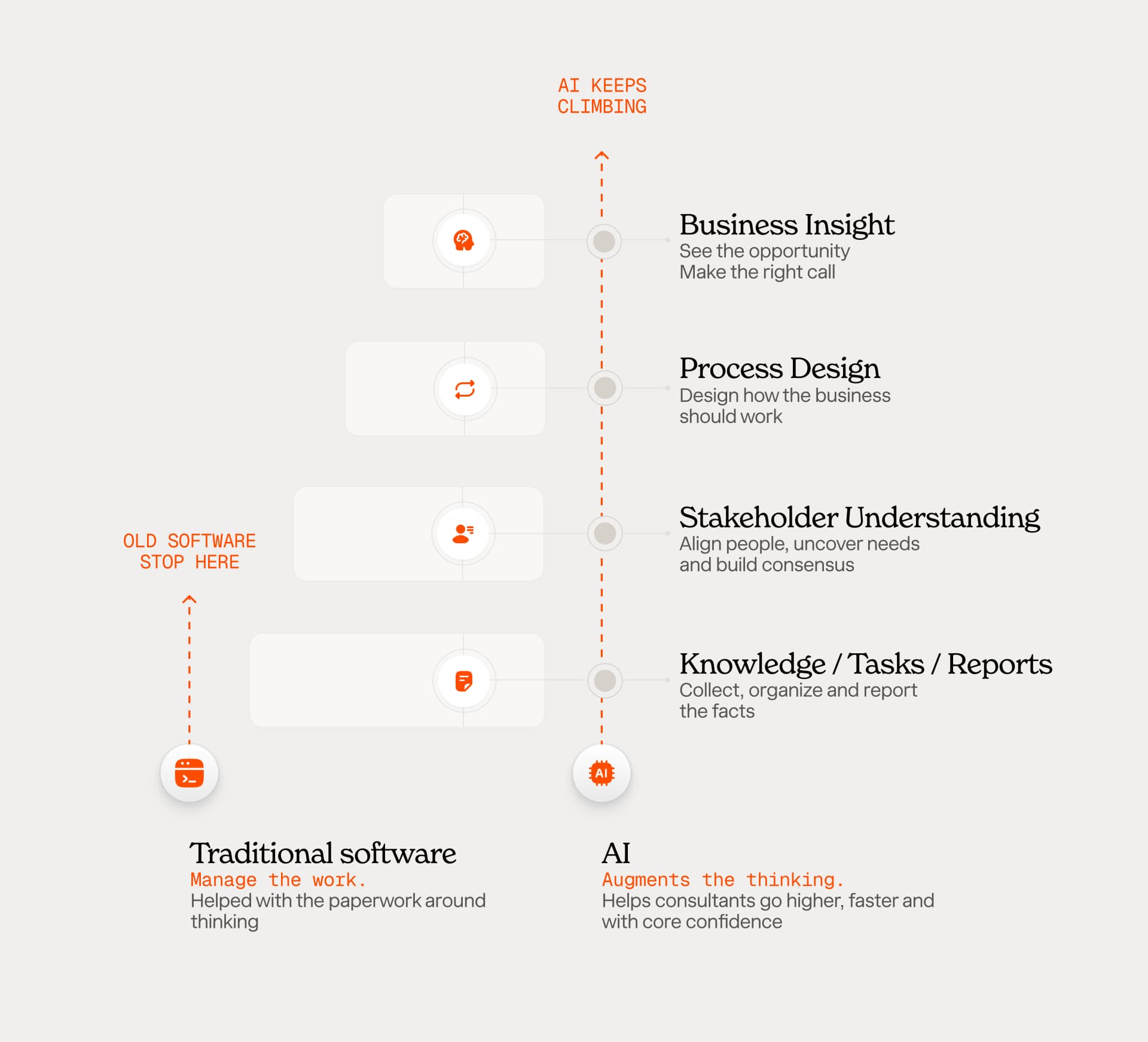
- —Software has only ever helped with the paperwork around thinking, never with the thinking itself.
- —AI is the first technology that targets the thinking directly, which is fundamentally different from traditional tools.
- —This breakthrough may finally shift failure rates that have remained stubbornly high for decades.
Understanding what consulting really sells
When you hire a consulting firm to guide you through a large transformation, you're paying for two distinct things: a very human skill (pulling facts from your organization, understanding your actual business processes, and spotting real opportunities for improvement) and a solution skill (knowing which fix will actually get adopted once proposed).
Together, that combination is an art—one of the hardest things to do well in business, and even harder to teach.
The breakdown at scale
In small firms, people learn this art through osmosis, watching how the best consultants work. But grow past a certain size—somewhere between 200 and 1000 consultants—and something breaks. Teams spread across cities, projects expand, and the expertise that made the firm good in the first place stops transferring naturally.
This matters because business transformation success depends on more than headcount. It depends on whether the expertise, decisions, and lessons learned from thousands of past projects actually reach the team delivering yours.
The cost of getting this wrong is concrete and lands on you, not the firm. One of our aerospace manufacturer clients faced a $500,000 scope dispute because decisions between their team and their systems integrator never got properly tracked. Another client fired their SI outright and had to rebuild an entire project from scratch.
These situations happen far more often than most admit publicly. They're not the result of people failing at their jobs—they're consequences of the sheer complexity and volume of decisions, conversations, and dependencies in modern transformations.
The problem that won't go away
This has been a persistent industry challenge. 80% of large business transformation projects fail to meet budgets and timelines, with even more failing to hit their intended business outcomes. Failure rates on that measure reach as high as 99%. What's striking is that this number has barely moved in years. Despite decades of evolving project management software, the industry has improved how projects are tracked, but not the underlying reasons they struggle.
Why AI changes everything
AI is the first technology that works with the human layer of transformation instead of just organizing the paperwork around it. It targets the thing your consulting partner actually sells you—intelligence and knowledge—not just the scheduling and reporting layer that project software has always handled.
That's a much bigger deal than another productivity tool. It's a genuine opportunity to make the hardest part of the work more consistent, without flattening the art that made it valuable in the first place.
What this means for your project
If you encourage your SI to start testing AI now—even in small ways—you put your project ahead of the traditional approach and improve your chances of avoiding the failure patterns that have plagued transformations for years.